
大家好!I have been in Taiwan for around 2 weeks now, and I am here to share what happened this week. My classes are getting a lot better because I am getting used to the heavy workload, and my teacher’s teaching style. Despite this, I still haven’t gotten used to bringing toilet paper into your stall before going to the restroom, and I might’ve forgotten while at school. Even though so much happened at school, the key part of my week was this weekend. Over the weekend, I met my host family for the first time. Normally, we are in a hotel on weekdays because I have to go to classes, but we stay with our host families every other weekend. This weekend was my first time meeting my host family, and I was really nervous, but I ended up having so much fun. My host family consisted of my host mom, dad, and two host siblings ages 9 and 7. My host family took me and Carson all over Hsinchu, but some of the highlights for me were the 擂茶(Pounded Tea) DIY. It was very good, and I wanted to take some home. Another highlight from my weekend was when my host family took me to a petting zoo, and I saw a capybara for the first time! Seeing a capybara was honestly a life-changing moment, and it made me very happy. Besides all of the great excursions my host family took me on, I noticed so many different things during my time with them. Before leaving to live with my host family, I thought that living with my host family was going to let me escape the “American Bubble” and only practice my Mandarin, but I was very wrong. Both of my host siblings were very westernized watching movies like the new Super Mario Movie, and asking me if I listen to Michael Jackson. One of my host family siblings saw a picture of my friend Jacob, and asked me if that was Michael Jackson. I laughed and responded by saying 不是,我的朋友。 No, my friend. She replied saying 迈克尔杰克孙是你的朋友? Michael Jackson is your friend? Despite noticing some very Westernized traits, I also saw many cultural differences like turning off AC in a room when you aren’t in it (a foreign idea for Floridians who enjoy freezing themselves with AC). Or my host family stuffing me with food nonstop, despite me saying I am full. After we got back to the hotel from our host family, Carson told me “Bro, you were a trooper, I don’t know how you managed to eat all of that food, but I was rooting for you the whole time”. Overall, I had so much fun this week, and I am so excited to go back to my host family soon.
Month: July 2023
Interview with Jeffery Ding
你好!I am back with another very interesting post regarding AI. 我觉得人工智能最近随处可见,但是很多人抓不住人工这能的重点。(I think AI has recently been seen everywhere, but many people can’t grasp the importance of AI). To help myself and you guys understand more about AI, I interviewed Jeffrey Ding an assistant professor of political science at George Washington University who published a newsletter called ChinAI where Ding posts weekly translations of Chinese language writings about AI-related topics
Questions I asked:
Why did you make ChinAI?
Ding was inspired to start ChinAI after researching AI in China, and after sharing these articles with friends and colleagues at the Center for Governance of AI, and there was a huge demand for it. The demand for more translations led to Ding forming a newsletter which is how ChinAI was formed.
What was one of the interesting articles you have translated?
Ding replied saying that one of the most interesting articles he has translated was from a Qinghua Professor of Law Lao Dong-yan (勞東燕). The article was a very strong criticism of the Beijing Metro, and their attempts to install facial recognition in the subway for security. Ding thought that this article was very surprising because of the criticism out in the open and that this article shows that there is some pushback from Chinese citizens/academics against intrusive applications of AI.
After this question, I talked about a previous conversation in a different meeting where Ding talked about a guy that went into a real estate firm with a motorcycle helmet because the firm would use face ID to discriminate against customers, and the motorcycle helmet guy became viral. Ding replied saying that one of the largest issues with Face ID in China is price discrimination, which is one of the reasons why Ding believes that this went viral. Ding also talks about how because of the motorcycle guy, there was a lot of pushback from Chinese citizens which led to China trying to add more stringent personal information protection regulations, but it hasn’t been approved yet, so we shall see if companies will be willing to comply with these regulations.
I have been studying the war over semiconductors specifically in China, and I have been seeing this common theme of China copying many people’s ideas outside like the US, and do you think that this will eventually lead to the downfall of China just because they are copying a lot of different things? I also gave Ding an example from my research which was talking about Huawei using American semiconductor chips, and after the US cut off chips being sent to Huawei, the market crashed for Huawei.
Ding replied that my example talked more about the machines making the semiconductor chips. Ding also says that since the US has a strong lead in semiconductor manufacturing, even if Huawei knew how to make their own chips, it would be very difficult for them to replicate them because Huawei doesn’t have the advanced machinery that the US has to make semiconductors. Ding does agree though that part of the reason is that China does rely on foreign suppliers for key parts of the semiconductor chain, but he reminds me that in general that everyone is reliant on others. So even the US doesn’t have a self-sufficient semiconductor supply chain. Most of the US’s advanced semiconductors are manufactured in Taiwan, even though they are designed in the US. Ding believes that China is trying to take control of a part of the semiconductor supply chain where they can be very strong so other countries can’t cut off their access.
The next question I asked Ding was regarding one of the articles he translated called Taiwan Skin Mainland Bones. I was curious why Taiwan uses Chinese tech. https://chinai.substack.com/p/chinai-214-taiwan-skin-mainland-bones
This article was looking at specifically why Taiwanese surveillance was the same as a Chinese product from Hikvision. The main reason is that it is very difficult to enforce things like Made in Taiwan, Made in China, or Made in the US because you can’t just slap that onto a product. Part of the reason why they are relying on Chinese equipment is because it is cheaper, and it is one of the leaders in surveillance, so the Taiwanese company that is partnered with Hike Vision benefits from buying cheap equipment and selling it under the Made in Taiwan. Ding also talks about how there were provisions for selling Chinese equipment under a different name and this was also another thing that was very hard to enforce.
I asked Ding a follow-up question asking if Taiwan was putting Made in Taiwan over Chinese products because of the relations between Taiwan and China.
Ding replied saying that it was because Taiwan made a prohibition on public entities from using these Chinese security products. This is because Taiwan is nervous about spying and espionage which is why the Chinese government doesn’t want public entities to use Chinese surveillance systems. Because whatever footage is being recorded or communicated could be given back to the Chinese government.
What is your view on Tiktok? I have been seeing alot of news reports on how the Chinese government is taking and stealing information from Tik Tok users.
Ding believes that there are very real concerns about what data is being collected, and whether the Chinese government has influence over that part of Tiktok. He thinks that the security risk isn’t that high, because there isn’t much of a risk for blackmail when it comes to what US officials are looking at on Tiktok. Despite this, Ding is far more concerned about Tik Tok being used as a platform that enables influence operations, supports and boosts content that is in favor of the Chinese government, and suppresses content that is against the Chinese government. Overall, Ding believed this is far more troubling than the Chinese government allegedly collecting information. Ding further supports his point by saying that the data collecting is very real, but if the Chinese government really wanted this information, this was something that they could probably purchase from a third-party supplier so he is not as concerned about that factor.
Overall, I learned so much about 人工智能 (AI) from Ding, and if you want to learn more, visit Ding’s newsletter https://chinai.substack.com/
Week 1 in Taiwan!!!
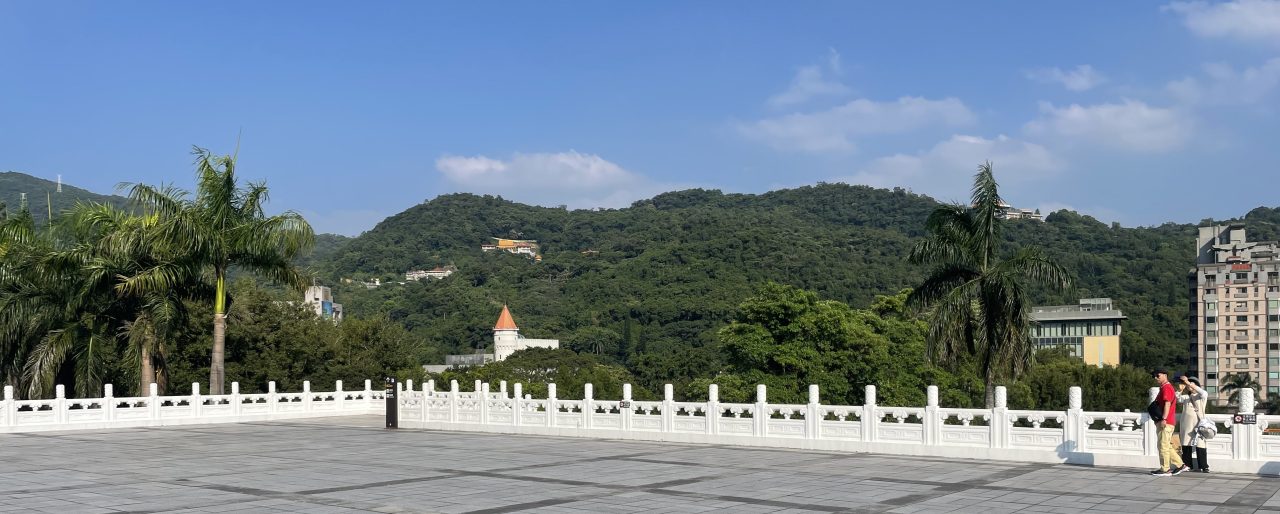
Hi guys! I have been in Taiwan for a little over a week and got through my first week of classes. For those who don’t know, I will be in Hsinchu, Taiwan this summer through NSLI-Y, a travel abroad program. I have only been here for one week, and so much has happened. One thing I have to say is that the food is great here! I’ve had so much good food like 牛肉拉面, 小笼包, and 火锅. Also, on this trip, I have been noticing the differences between American culture and Taiwanese culture. Before we got to Taiwan, our resident director was talking to us about common stereotypes of Americans being loud. When I heard that, I was kind of confused, but I soon realized how loud not only the group is, but how loud I am personally. This was evident on the bus where our group was being pretty loud, while everyone else on the bus was quiet. Another cultural difference would be that in Taiwan a lot of people use scooters, whereas the most popular mode of transportation in the U.S. is cars. As far as academics, the classes through the program are super rigorous, and I have had to study for long hours with friends, but it has still been enjoyable. I think my writing skills are improving, but I’m not sure. This weekend we went to Taipei, and it was super awesome. We first went to 中正纪念堂 Chiang Kai-shek Memorial. It was very interesting because 中正纪念堂跟林肯纪念堂一样. After we went to eat 小笼包 at Din Tai Fung. They were very good, and super cool because the restaurant we got them at was known for their 小笼包 and how they make 18 different folds on the dumpling. After that, we went to Taipei 101, which is the second-largest skyscraper in the world, and has the fastest elevator. The view from up top was very cool, and I was able to take a lot of pictures. I also got to see this huge ball at the top of the tower which was made to help the skyscraper stay balanced if there was an earthquake. Even though I was eating the best food, and visiting some breathtaking places, the highlight of my week was in the elevator when a little girl started counting in Mandarin as the elevator was going up. It was the cutest thing in the world!
 Domenic Speaks